


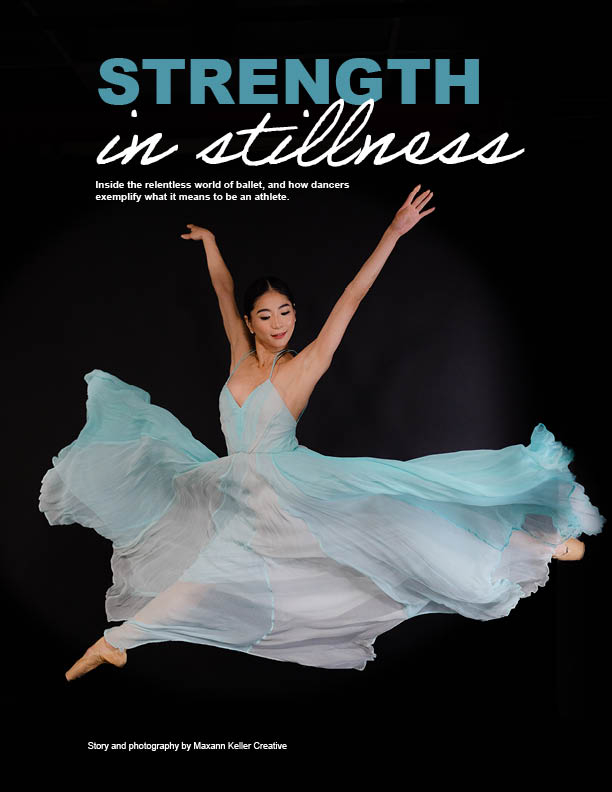
Story and Photography by Maxann Lockard | Maxann Keller Creative
Eri walked up to the studio in downtown Richmond with a bright smile. She greeted me with an armful of apparel that she thought would be fun to photograph, complete with a plethora of textures, extra loose fabric for movement, and a few different colors to play with. We decided to go with a blue flowy dress, a classical tutu, and a strappy leotard.
I had never met Eri before today, having only seen her performance recaps and on-stage stills on her Instagram profile. But I could tell from the instant she approached me outside the brick loft where the studio sat, she was a professional, and I was drawn to her magnetic, bubbly personality.
While setting up the room, we chatted about her craft, a passion that fuels her wildly fulfilling career as a professional dancer. She emphasized the significant time she dedicates to ballet, including some 12-hour days of practice, coaching, and mentorships
Her comments during the session were insightful. I was fascinated. As a track runner and frequent marathoner, I was always under the impression that strength was derived from intense lifting, sprints, long runs, and HIIT. I carried a massive misconception that dancers were always the slender, “dainty” artists. Not the typical “athlete” you’d compare with the likes of a CrossFit athlete, runner, or soccer player.
When I returned home from the shoot, I couldn’t help but start editing the photos immediately, eager to see what we had captured in our two hours in the studio. At the same time, I was intrigued and curious to learn more. I knew there was a great deal about ballet and classical dance I didn’t know about or understand.
I set out on a mission to learn more about the comparisons between dance and other sports. My interest piqued when I saw the research accumulate around just how much work, strength, and grit go into being a part of the prestigious ballet.
———————————
On stage, ballet may appear effortless; a floating arabesque, a pirouette that spins with no hint of strain. Yet behind that illusion is a rigor few audience members ever see. Professional ballet dancers spend hours each day drilling technique, rehearsing choreography, and conditioning their bodies. The repetition is unrelenting; the workload is akin to that of elite athletes.
In my research, I found one recent study of German ballet companies that revealed over 96% of professional dancers experienced at least one injury within a single season, and more than half of their working weeks were affected by a health problem significant enough to reduce their performance (Wanke et al., 2024).
Even more telling was that injuries most often occur not on stage, but in the corners of rehearsal studios. Nearly 42% of injuries happen during rehearsal, and another 26% in training (Wanke et al., 2024). The artistry seen on stage is not just the product of grace but of relentless athletic preparation.
—————————–
Ballet, perhaps more than any other art form, embodies a set of unspoken rules about the body. Long lines, fluidity, and control are celebrated, but they demand constant conditioning. Dancers learn early that maintaining this form requires a careful balance of strength and restraint. This pressure to conform to a particular ideal often translates into strict expectations surrounding body composition, training routines, and daily nutrition.
Recent research highlights the fragility of this balance. Many professional dancers operate in what sport scientists describe as “low energy availability,” meaning they consistently consume less fuel than their bodies require to maintain both health and performance (Norton et al., 2024). With grueling demands stacked upon them, professional dancers must prioritize a number of disciplines in order to continue their craft and meet exceedingly high standards.
While the stage celebrates the beauty of line and grace, the backstage reality is often one of austerity and sacrifice. And yet, in every leap and extension, they transform strain and strength into poetry. The fragility of the human body transforms into durability, becoming a captivating canvas for art, only capable by those who genuinely understand what must go into it to make it exceptional..
As I delivered the album to my new friend and subject, I could only hope these photographs captured some aspect of her triumph: the incredible beauty she creates and exudes through movement. I hope it helps to showcase the moments when discipline, suffering, and artistry converge into beauty that feels weightless, or dare I say, effortless.
I will never forget this shoot with Eri. Her kindness, sweet demeanor, and willingness to give up two hours of her weekend off to spend in front of the lens of a complete stranger who was eager to learn more about an art form that was so very foreign to her. She did (and continues to) inspire me. Opening up my eyes to the idea that strength and grace do coexist, and oh so beautifully.
References
Norton, C., Ma, W., Bartholomew, E., Guppy, F., & Close, G. L. (2024). Energy availability and dietary intake in elite female ballet dancers: A cross-sectional analysis. Nutrients, 16(24), 4293. https://doi.org/10.3390/nu16244293
Wanke, E. M., Gobbo, M., Miller, M. R., Huth, K. C., & Thiel, C. (2024). Health problems in professional ballet: A prospective study of injury and illness incidence and risk factors across three German companies. Sports Medicine – Open, 10(1), 12. https://doi.org/10.1186/s40798-024-00753-1
Weiner, K., Wadsworth, D. D., & Arent, S. M. (2024). The relationship between dance training volume, body composition, and habitual diet in female collegiate dancers: The Intercollegiate Artistic Athlete Research Assessment (TIAARA) Study. Research Quarterly for Exercise and Sport. Advance online publication. https://doi.org/10.1080/02701367.2024.2398047

